A calling ...

"We are called to be architects of the future, not its victims."

"Make the world work for 100% of humanity in the shortest possible time through spontaneous cooperation without ecological offense or the disadvantage of anyone."

- Buckminster Fuller

Saturday, December 13, 2014

Ray's wife speaks

For me, Ray Kurzweil is an absolute must follow. That Ray has posted work his wife, a psychologist, does with children is significant because I never really thought of Ray Kurzweil as a person who is brilliant, but as some objectified genius. One of my nagging questions as an educator with ADD is how to systematically integrate technology into my practices to increase my teaching efficiency.

Yet, at home I struggle with the reality of a High School Student who, if I did not take such a hard line on it, would be in a constant state of "gamer rage." Baseball is a replacement activity, for which my wife spends considerable sums on a private hitting instructor, baseball camps, etc, whereas the violent games are like the ring from Lord of the Rings, which turn Schmegal into Golum.

Yet at school, I see a generation of students who seem crippled by an addiction to their technological tools, I often reflect upon the scene in the movie Wall-E where the fat humans struggle to rise, while the tune from 2001  puts a bow tie on the ironic allusion. Technology is largely a contributor to learned helplessness. Even my brother Mike, an IBM engineer who wants to build drones just for fun, worries about the impact of too much screen time on children.

What's needed, Mrs. Kurzweil suggests, is a more purposeful, more thoughtful consumption of technology.


Wednesday, December 10, 2014

Working Smarter

My Edmodo Library

Okay, why haven't I done this before? Edmodo is my new favorite educational website. I've had the tool for over a year, but I never started using it until a few weeks ago when my ASUS Vivotab Note 8 tablets started to arrive and I started getting serious about my project of setting up a "technology center" in my classroom.


Here are 7 things I love about Edmodo:

  1. Edmodo is Free (I think), but even if it is not free, it is well worth the money ...
  2. Edmodo is social media on steroids for teachers. Teacher's can post to communities and, amazingly, teachers throughout the world respond with suggestions.
  3. Edmodo offers a safe environment for teacher - student collaboration (somehow, they vetted my credentials (required me to take a photo of my ID badge and I had to provide my work email)
  4. The library function is easy to use, has a graphical interface, and amazingly, your library can be easily shared -- check out my links by clicking above. Yay!
  5. A suite of free cutting edge classroom management tools is included.
  6. The discovery tool provided "gifts from god" -- I just played with the discovery button tonight, It offered a gold mine of resources that I can use tomorrow -- yes, I really should be sleeping, but this stuff is money in the bank!
  7. The free apps available through the app launcher are beautiful, beautiful, beautiful
Okay, I have stories to tell, but I really need to get to bed. Will share when the spirit moves me.

Saturday, December 6, 2014

A little irony


I almost died laughing this morning when I got a message from the COSMOS in my inbox. Apparently, I am "attracting" clients who don't appreciate what I give them. I've shared the message from the COSMOS below. Hah!

One of the themes discussed at the copier and in the halls is "a culture of entitlement" we teachers are seeing from an entire generation of students, students who expect everything to be handed to them, including "the answers," supplies, and even entertainment. My uncle Harold's favorite aphorism is always in the back of my mind: "No good deed goes unpunished." Yet, I work the hours that I do and accept my daily punishments with genuine gratitude.

By choice, I work in a pretty hostile environment. Many of my students have a long history of academic failure. I battle daily with a phenomenon I call "the Special Ed Mafia," students who have been concentrated into self-contained classrooms, where the put-downs and negative self-talk are constant and corrosive, where the silly and the absurd are celebrated, and academic performance is both envied and mocked as "nerdy" and "boring." Unlike some of my more seasoned colleagues, I confront academic failure head-on and take the time to make the calls home, because I want a response. Occasionally, I receive a favorable response.

On Thursday, a parent showed up to school and got the Counselor involved. Yesterday, I met with Mr. Kamarra and the Counselor and another Special Education Teacher, Mr. McDuff, who seems to have "better control" over Tim, who has a class average of under 20% in my classroom. McDuff and I have different approaches which were best illustrated by his comments to the parent: "School is difficult for Tim." My approach, because I am still a rookie, is that students with learning disabilities are expected to learn the same curriculum and that my job is to make the curriculum more accessible. Bottom line, I am holding students to a higher expectations than Mr. McDuff, which may partly explain why I appear to have more conflict with my students.

McDuff had seen the same interfering behaviors that I had seen, but he was brutally honest, "If a parent doesn't care enough to call, I won't make the call." As we parted, the parent suggested that I send home an answer key so that the father could help work with his son. "What a great idea!" I replied. Since I already work every problem I assign anyway, I told him that I could send the answer keys home in a sealed envelope.

Here's a little story that happened to a general education teacher this week in the room across from mine. It's a good illustration of the entitlement mindset we see every day that seems like a generational thing, Jane had a special pen on her desk that was stolen. Jane had explained to her classes that. during her first year of teaching, a student had lost the pen, and that when she found it she handed it back to him. The student replied, "That's okay, I want you to keep it so that you can remember me." Like many teachers, Jane is the prototypical generous teacher who often provides snacks, works after school with students, etc. 

This week, Jane learned that Vinh, a small, normally well-behaved 6th grader, was bragging to his friends about how he had stolen Jane's special pen. Jane was crushed. "No good deed goes unpunished," I told her with a wry smile.

When Jane confronted Vinh he quickly burst into tears. Jane had come to my room and was sharing her plan to have Vinh, as a consequence, write a multi-paragraph apology essay during after school detention. I replied, "It's a teachable moment." I recommended that Jane provide a little scaffolding to help Vinh, given his inability as a 12 year old to empathize with a teacher as another human being, learn how badly he had hurt her feelings.
:
1: How would you feel if someone stole a personal memento from you?
2. How will your parents feel when they learn about this incident?
3. What will you tell a friend if he is considering doing something similar?

Maybe Vinny will think twice the next time before accepting a dare. 

Occasionally, one of "the seeds" I plant takes root, Since my call home before Thanksgiving to Jasmine's mom, who apologized for not responding to my calls because she had been in and out of the hospital with kidney problems, and apologized because she is unable to help Jasmine with her homework because of her poor English, Jasmine has been coming for after school help several times per week. My reward was seeing Jasmine doing problem after problem using the order of operations correctly, in stark contrast to Jasmine's class, where I have a majority of students who seem to barely even have a pulse. They throw erasers, highlighters, giggle constantly, or just sit there with dull expressions and seem incapable of following even the simplest instructions. Yesterday, with a half a year's worth of exasperation, I complained to the class, "This is what an insane asylum sounds like."

On Wednesday, since Jasmine had come for after school help, I was able to assign a tutor from a local high school that is one of the top high schools in the Nation. We have one of the top high schools in the Nation right across the street from my school, My school has one of the highest free and reduced lunch percentages in the area, an indicator of high levels of poverty. While working with Jasmine one-to-one after her tutoring session, Jasmine revealed to me that she would like to go to college, that after school is fun, and that she could not understand why more of her friends were not coming. The very next day, Mrs. Larime walked to class with Jasmine. They were late. When I came to the door, Mrs. Larime explained that Jasmine never reads during her class so she was having a conversation with Jasmine: I replied, "Jasmine will respond if you reach out to her."

Jason, whose dirty blond hair is always over his eyes, who never fails to hide his boredom, has also responded positively to my Thanksgiving Eve calls home. On Thursday, Jason was on the winning team with Kendra in our "Footloose" order of operations game. The students won't be able to get "Footlose" out of their heads, since it looped continuously while students went back and forth to get their playing cards. Big Al was singing Footloose. Everybody was dancing. That I was able to let the class choose their own partners and do an activity like a normal class was a moral victory. That something appeared to stick was glorious!

When I called home yesterday to celebrate that Jason had been a winner in our Footloose game, and that his improvement was noticeable, Jason's mom shared with me a gaming analogy she had used to motivate her son: In order go get better at your game, you have to play lots of games," The mom has been making Jason practice with fraction computations, and while he still is doing about four-fifths of steps correctly, that's two-fifths better than he had been doing.

Tonight, I will celebrate the holidays at my wife's company's final party in the DC area. We will be at the Washington Hilton. There will be an open bar, black jack tables, and one of the largest ballrooms in the area will be lined with carving stations, pasta stations, Every couple will get a door prize. The irony will be delicious.

***
I'm envy you, Daniel.

You might wonder,

"Why would The Cosmos be jealous of me?"

Quite simply, because you get to LIVE!

Your life is unique, one of a kind,
and you're surrounded by Mystery!

(There's no mystery when you are
EVERYTHING, like me...)

You get to wake up every morning
and look forward to the new experiences
I'm going to send your way!

How awesome is that?

It's like you're watching yourself star
in a movie that never ends, and you
have no way of truly knowing what's
going to happen.

And the best part is,
you get to choose your own adventure!

You can't choose how tomorrow will go,
but you can go out and plant the seeds 
that will blossom into the most beautiful
stuff you can imagine.

You just have to choose the right seeds.

Now, the truth is there are two types of "seeds"
you can plant...

The seeds that are going to bring you very
poor, unable-to-pay-you-what-you're-worth
headache-inducing clients...

OR the ones that will bring you really 
affluent, great to-work-with clients...

Who are happy to pay you what you're truly worth 
(which is probably way more than you're 
getting paid now)...

SO....

The question is, who do YOU want to attract? 

If you said the kind of people who will 
actually pay you well, and appreciate your
work, well then the next question is...

WHERE and HOW do you find those people?

Well, I have good news for you today. 

This is where you find them:

http://www.healthywealthynwise.com/bill-baren2

The best part is, it's totally free (as many,
but not ALL good things in life are ;-)

Just click the cosmic energy flower of your future
and grab your free ebook on how to
plant and water only the seeds that
will attract your highest paying clients:


Listen. 

You're too incredible to spend your
precious time working with anyone who
doesn't appreciate you completely.

This little guide will help you to sort
through the bad "seeds" and zero in
on the ones who will love your work
(and pay you generously for it)!

http://www.healthywealthynwise.com/bill-baren2

Now go and garden away, you beautiful, 
lucky You!

Love always,

The Cosmos

P.S. I am not sure how long this amazing free
book will be online (in the cosmic sense of time,
probably for about a nanosecond) so please 
grab yourself a copy while it's still there! 

http://www.healthywealthynwise.com/bill-baren2

*This note has been forwarded on to you 
by Ric & Liz Thompson as "The Cosmos" 
was not sure of your email address.  

Ric Thompson
Founder
Healthy Wealthy nWise Magazine
Small Business CEO Magazine
Internet Marketing TNT Magazine


Friday, November 28, 2014

A stream of consciousness

The musical stream flows like a rushing dream.
It whispers, ripples, pools, and plays back scenes.
With gravitas it channels memories.
Everything is washed into the sea,
Except  some sticky remnants that line the shore.

The musical stream flows like a dream
Whispering merrily, meandering along
Temporal pleasures and sad song treasures
It filters and files as memories. 

The stream is but a dream
A flow past an unseen sea
A whisper of today.

Yesterday
Today together

 Flows ...

Saturday, November 22, 2014

My kids can't do long division. Time to try something different ...


    Partial quotient method of division: An alternate to traditional long division


If a typical 6th grade student is given the same simple fraction computation problem over and over over, one that only involves just a few simple steps, such as a simple fraction multiplication problem, eventually after a few trials most will remember the steps, be able to mirror them during direct teaching, do it on their own during guided practice, and are quickly ready for independent practice. Even if a typical student does not fully understand why each step is required, most can at least match, mirror, notice a pattern, and do a series of steps independently. Not my most at-risk class for which I am being challenged to teach 6th grade curriculum when only a few can perform 3rd grade division, even during guided practice. Independent practice? What a joke! Solving word problems? Heartburn!

Even though the steps are posted, with each step a different color, the ability of most of these students to follow a simple multi-step procedure breaks down after about the second or third step, leaving many of these students smiling obtusely, sitting like bumps on a log. After multiple repetitions of the same problems, the majority can at lest perform steps one through four and are able to get to the fifth step when they must change an improper fraction to a mixed number or reduce a fraction to simplest form, a step that involves division. I give students credit for 80% of an "exit ticket" problem. I give students unlimited opportunities to do retakes throughout a quarter, but only a few take advantage of my unlimited opportunities policy. Only a few care enough about their learning to come for help after school or during lunch, so I am constantly trying to chase squirrely students down. The lack of independent learning skills, lack of stamina, and overall listlessness is maddening! 6th grade math is a life skill, but these kids in self-contained classrooms just don't seem to get it!

Long division has been problematic largely because most of these students do not know their multiplication facts. Most have no automaticity with their addition and subtraction fact families to 20, which makes computation without a calculator virtually unbearable. The root of the problem with division seems to be a general inability to follow multi-step procedures, even if they sort of get the concept of equal grouping. I noticed Lena getting stumped by the concept of how many 7's go into 63, guessing 6 instead of 9, looking puzzled as usual. After observing Grant successfully solve a fraction multiplication problem using what was a combination of guessing and repeated subtraction, it suddenly dawned on me that my "division problem" is not going away unless something changes drastically. Division is becoming a black hole, a destroyer of motivation for frustrated learners.

Time to try an alternative strategy. What I like about the partial quotients strategy is the way it allows students to chunk a larger number down even if they cannot quickly find appropriate multiples of a divisor to find "the right" quotient. Close can be good enough, Even not close can be good enough. All students need to remember is that, whatever multiple of the divisor they choose, the product cannot be larger than larger than what remains of the dividend, (or the amount that is being divided). Having studied partial quotients for a few hours, having found a few well-written notes, and having found a nice video courtesy of Khan Academy, I am ready to teach the partial quotients strategy, and praying that this strategy will prove to be a magic bullet!

On Monday, even if students can take advantage of the visual scaffolding and explicit strategy cues I have provided on their quiz, which I spent over two hours after school yesterday modifying and perfecting with feedback from a master teacher who works with intellectually disabled students (students with IQ's below 70), I expect most to still fail because they cannot perform the computations. My value added chart for my self-contained students remains mired in the red, but hopefully I can pull a few of these students up a little.
Saturday, November 8, 2014

An allusion to Robert Frost

Stopping by the creek on a Saturday Morning


These woods are ours, we know them well
Long in the suburbs we have dwelled, also
No one will see us stopping here to hunt for stones where tribes once dwelled.

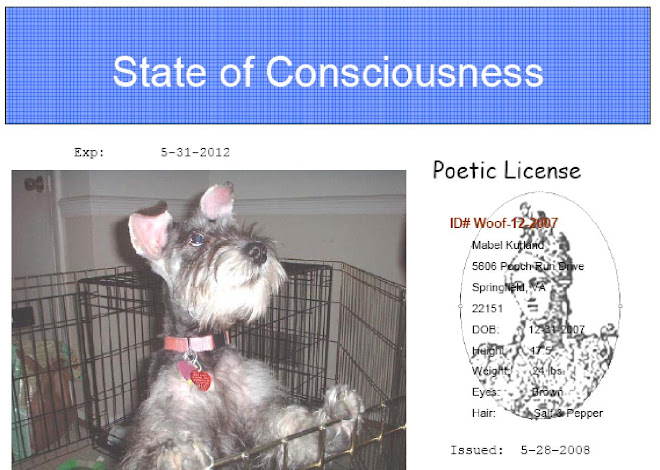
Mabel knows this is our norm to escape from the suburban swarm,
Between the Potomac and Accotink Creek, on any given Saturday morn.

She snorts and gives her head a shake
She knows that there is no mistake.
The only other sound’s the stream and rustling leaves and referees.

These woods are sanctuary from the swarm, but I have promises to keep
And every day’s another step.

One step at a time. One step at a time.
***
I can still recite "Stopping By The Woods On A Snowy Evening," by Robert Frost from memory. My second grade teacher, Mrs.Brown, had everybody in our class recite it, and it has stuck with me through all these years. As I walk with Mabel in the woods, I often repeat it from memory.

Saturday, November 1, 2014

Olfactory Joy

Savor the garden.
Would that time permitted more
Olfactory joy

This grey and haunting November morning, Mabel briskly led a meandering path along the dappled borders of the greens, around the calming fountain, past the lillypads, down to the spring fed stream. We trudged across the pied leaf strewn bridge, up the hill to the nursery at Green Spring Gardens, and back to my Chevy truck. Today amidst the gloom, I followed pensively. Mabel's nose savored fall's scents in lusty breaths while I observed fall's colors and searched for the right words, Saturday sniff walks are my reward for her patience with my daily dark arrivals, to which she unbregudgingly brushes her door bells, snorts, and greets me with howls of joy, however late I arrive. 

It's been a brutal week with the Quarter 1 Math test having been a bit of debacle for certain squirrely students for whom the 6th grade curriculum, despite accommodations, for various and sundry reasons is not sufficiently accessible. Far too many of my students are not responding to what I would consider reasonable interventions and accommodations, Bi-weekly progress reports indicating failing grades, calls home to parents, and the future prospect of never graduating from high school have often seemed to have fallen on deaf ears of students for whom academic failure has become far too excusable. When I post my grades later today, tomorrow, or Monday, I shudder to think about how many F's will remain, despite consistent opportunities I provide to students to raise their grades. This week, I jealously observed the converse, a student in another classes being consoled by a teacher after receiving a C on the Quarter 1 Final. Why is it that my students have become numb to academic failure and remain so resistant to becoming engaged learners?

I have limited homework, maintained a consistent homework checking procedure, adjusted seating, pruned the classroom environment to eliminate visual clutter, made the content more accessible for students who have audio and visual motor processing problems by reducing writing requirements, by using color to help students distinguish procedural steps, and by adjusting my pacing. I have regularly communicated with colleagues to see what is working in other classes. I have held students for Lunch Bunch, sometimes involuntarily, but mostly voluntarily, held students for After School Detention when discipline issues have arisen, but used the time to help students complete missing assignments. have maintained daily office hours, made myself available to parents, worked one on one after school on Fridays with some of my extreme cases. How is it that so many 6th graders cannot read, write, or do simple math, while remaining blissfully ignorant of the long-term consequences of academic failure? What do I need to do to help students understand that academic failure is largely a result of lousy choices?

Fortunately for my sanity, during the last few weeks of the quarter, responsiveness to my interventions seemed to gain a little momentum. A few students in my self-contained classes finally did show a little life, particularly those who enjoy a little structure at home. I treated a few who stayed after school, after calls home to notify parents that their students were failing got their parent's attention. to a real-time demonstration of the effect of changing zeroes to A's in the grade book as I allowed students to turn in missed assignments with teacher assistance,

By the end of the week, Hector, who for some reason as a 6th grader still hasn't learned how to modulate his booming voice or learned how to refrain from routinely inappropriate comments in a classroom setting, was asking to stay with me after the other students left so that he could work with me one-on-one. A month ago, Hector mocked me after I revealed to him, "I am the silent assassin, you may have gotten away with your rotten behavior last year, but I won't stand for it -- I'll contact your soccer coach." By the time Hector left at 5pm on Thursday, Hector was starting to sort of get fraction multiplication, although since he has never learned his multiplication facts, he has difficulty finding common factors and common multiples when reducing fractions. Hector is one of the lucky ones. His parents care. His soccer coach supported him with a decision to not allow him to play until he raises his grades up.

After I sent Hector home at 5pm because it would be getting dark outside, I broke for a quick bite at Thai by Thai, which recently opened in the Bradlick Shopping Center, What a delightful surprise it was to enjoy a hot bowl of noodles in such a tastefully decorated little restaurant. I hope they make it, as I was the only one in there, There are simply not enough quality restaurants in Springfield. What a huge disparity between the quality of their food and decor and their prices. Another example that the economy sucks and nobody has any money! Instead of returning back to school which I typically do to eliminate as many risks as possible, I went home and took Mabel for a long walk along the creek behind the Audrey Moore Recreation Center. She excitedly pulled me further than usual in the cool October twilight. Thankful I was that I had managed to pop my back and was able to walk my dog through the woods without much of a limp, after had I limped home late Wednesday evening barely able to walk.

Unfortunately, far too many of my students in my self-contained classes do not enjoy reasonable parental support, or suffer from an inability to persist or handle the truth that how they have been approaching their responsibilities has not been good enough. On the second day of testing, I had Jasmine call home because she could only answer a few of the 27 questions, I finally reached her mom, who apologized for not returning any of my calls and requests for a conference because she has been in the hospital suffering from kidney problems. Both she and her husband, she apologized, do not know enough english to help her daughter with homework. Jasmine's mom wants to conference with me on Tuesday during my Teacher work day. Of course, I will accommodate her. All throughout the 1st quarter, I have been begging Jasmine to stay to work with me so that I can help her, because I have seen enough to know she can do better, Now, maybe Jasmine will begin to stay a little more consistently. Dontae was on a roller coaster all quarter. Perhaps he felt that if he tried to be nice and stay and come for help every once in a while it would be good enough, while I bent over backwards to make his time enjoyable, but I wouldn't stand for it when he threw paper wads at his friends while I was teaching a lesson. He responded to being held from participating in Dance Club until he served his time in After School Detention by quitting the club. Habitual failure is a hard habit to break.

Legal precedent exists for schools to withhold supplementary aids and services to students in cases where no clear educational benefit is evident (Board of Education v. Rowley 458 U.S. 176, 102 S. Ct 3034 (1984). At my school, the culture is to provide the maximum support and opportunities, and the result is our school performs on par with schools with students who enjoy far higher socio-economic status. "[Rowley] held that IDEA's appropriate education" requirement includes a process and an opportunity to benefit." (Turnbull, H., Stowe, M., & Huerta,  N., 2007). Thus, we have procedural due process to guarantee FAPE (a free and appropriate public education, but procedural compliance is not good enough.

I feel the burden of noblesse oblige, a concept I wrestled with when challenged with descriptions of "sublimated idealized selfishness" in Lord Jim. which I read as a senior in high school. I don't know if dad has already given his speech to the War College, but his opening line, an allusion to Diodorus Sicolus, is something I reflect about often. Somehow, I need to help students understand that, ultimately, they are responsible, and that I don't give grades, grades are earned, and that grades have lasting consequences.


References:
http://www.cesj.org/wp-content/uploads/2014/10/jtw-graphicoverview-2014.pdf

Turnbull, H., Stowe, M., & Huerta,  N. (2007). Free appropriate education: The law and children with disabilities.  Denver: Love Publishing Company.

Board of Education v. Rowley
458 U.S. 176, 102 S. Ct 3034 (1984)