A calling ...

"We are called to be architects of the future, not its victims."

"Make the world work for 100% of humanity in the shortest possible time through spontaneous cooperation without ecological offense or the disadvantage of anyone."

- Buckminster Fuller

Saturday, January 18, 2014

Overcoming an Unresourceful State


Bryan is a 12 year old who has taken a few emotional hits over the past few weeks. Because I have had so many of my own problems, because I tend not to dwell on other people's problems, and because my focus during the school year is so narrowly focused on the prize, academic success, Bryan's emotional problems over the past few weeks have registered in my brain as chatter. I have, quite frankly, tuned them out.

Oddly enough, my room seems to have become a haven for students seeking shelter from the emotional storm. Perhaps students come to my room because I am so non-judgmental and I don't ask too many questions. Who knows?

Yesterday, during the 7th period Colonial America Test, Bryan had a panic attack. Since Bryan had been coming to my room to borrow my computer every day during lunch for the past week to borrow my computer to study for the big test, and since he had performed so well throughout the year on every other US History tests, Bryan's test-taking brain freeze came as a total surprise. When the bell rung at the end of 7th period, Bryan was only about a quarter done, had that deer in the headlights look, was mumbling about Quakers and Georgia, and his face had turned white as a sheet. For a 12 year old who was normally so resourceful, it surprised me to observe him in such an unresourceful state. I dipped into my neurolinguistic programming (NLP) toolbox, acquired from Tony Robbins' Lessons in Mastery. Tony's voice spoke to me, in a slow, deep, breathy tone, "You've got to chunk it down."

I joked, "Normally on a Friday, nobody stands between me and my dog Mabel, but you have built up enough equity with me. For you, I will make an exception. Call your mom and ask if she will let you stay and finish the test and see if she can pick you up when you are done." She agreed to let him stay.

We walked to the teacher's lounge and I bought him a Dr. Pepper. When Bryan opened his soda, his soda spilled over in the hall. Dr. P walked by with a teacher. I warned them to avoid the spill as I wiped up the spill.

Bryan and I went to the gym and grabbed a basketball from the supply closet. The group of teachers who play basketball were gathering. I never join them. Bryan and I went outside to shoot some hoops. I knew Bryan loves to play football, but I didn't know he was playing for his local basketball team and has a big game coming up. I kept feeding him the ball, reminded him to not drop his hands, but just shoot in rhythm. /We worked on keeping his elbow square, using his fingers to get a little backspin on the ball, and remembering to use his legs.

I knew that Bryan's grandma had recently passed away and had bequeathed her shotgun to him so that he could one day go out onto her farm and shoot squirrels, skin them, and make squirrel stew, but I had no idea that Bryan's dad had recently been sent to jail. Since Bryan is always wearing fatigues, and because of his ebullient outdoorsy personality, and since his voice dropped to a whisper whenever he mentioned something about his dad, and largely because Bryan's insights in class were quite often brilliant, I had envisioning his dad, Walter Mitty style, as some sort of CIA operative. Maybe I was also doing a little racial profiling, since Bryan is white, and since our school population is so diverse, because it never occurred to me that white kids have problems too.

As we were shooting buckets, Bryan kept wanting me to answer whether the Quakers were from Georgia, so I asked him to review with me the order in which the first 6 colonies had settled. Who settled these colonies, and what was their motivation. What was first? First was Roanoke Island. Who settled it? English settlers settled for economic reasons. Who was second? Jamestown. Who settled it? The Virginia Company of Londan. Why? Economic Reasons. Why did Jamestown become the first permanent English settlement? Tobacco. What was third? Plymouth. Who settled? The Pilgrims. Why did they settle? Religious persecution. They were Separatists. Forth? Massachusetts Bay. Who settled it? The Puritans. Why? Also religious persecution. Fifth? Pennsylvania. Who? Oh, the Quakers? Why? Religious freedom. Lastly? Georgia. Who? Quakers. Nope!

He could not remember the name of the people who settle Georgia, so I reminded him to think about the three regions. Why was New England settled? Religion. The South? Economic reasons. Middle Atlantic? a little of both. And where is Georgia? The South, so it must be economic reasons.

Bryan still could not remember. With his shoulders no longer slumped and his tension subsided, we went back to finish the test. Before I realized it, Bryan had pulled up the Power Point to find the answer about who settled Georgia. "Oh, debtors!" His mental constipation passed. I looked the other way, held my nose, and gave him a fresh start.

Bryan finished his online about 20 minutes, during which, I read aloud to him, an accommodation that is available to him, along with the screen reader he has available to him as a student with a Learning Disability. As we progressed, I asked him to read to me, and discovered that he reverses initial blended consonants, adds suffixes that are not there, and does not seem to break what he is reading into syllables. Are you dyslexic, I asked him? "Yes, he replied." I hadn't known.

I told Bryan about Dr. Roger Slakey, one of my most brilliant professors at Georgetown University. Dr. Slakey was rumored to have had dyslexia too. Nobody could break down exactly what the author was doing in a short-story or a poem, from the standpoint of style, i.e., grammar, logical sequence, imagery, and word choice, better than Dr. Slakey. Dr. Slakey had me analyze two different versions of Wordsworth's Prelude, the original, written as a young man, and a later more edited version, written after he had become an elder statesman of the Romantic Movement. Dr. Slakey once said, "Sloppy writing is a reflection of sloppy thinking."

Too many students ask for the answer rather than asking themselves, "what makes sense." What I'm noticing, particularly in math, but in this case in US History, is that when students focus on getting the right answer, they want to copy the work of other students, copy what the teacher is writing, and they become so worried about copying the right answer that they forget how to think for themselves. I learned that somehow, Bryan had written incorrectly on his study guide that Georgia was founded by Quakers.

A single misconception shut down one of the most resource students I have ever come across. As Dale Carnegie famously wrote in How to Win Friends and Influence Them, "The tiniest beetles can fell the mightiest oak. Don't let the beetles get you down."

Thursday, January 16, 2014

Well Stated

Thought I'd share one of my dad's more brilliant emails to a new neighbor is affiliated with a staunchly conservative organization and emailed my mom ... I am reminded of the many drop-ins by 7th Day Adventists over the years when I lived at home. Dad would always listen patiently, then counter proselytize. 
********************************************************************************************************************************************

Sean,

We oppose the big government agenda of many members of the Democratic Party.  And we support (1) limiting the economic power of the State, (2) restoring the free and competitive market system for determining just prices, just wages and just profits, and (3) restoring the original principles of private property, especially in corporate equity.  However, we are disappointed in the total failure of most of today's conservatives to promote the goal of (4) equal opportunity for every citizen to become a capital owner.

The Virginia Declaration of Rights, authored by George Mason and adopted on June 29, 1776, reads: 

"All men are by nature equally free and independent and have certain inherent rights, of which, when they enter into a state of society, they cannot, by any compact, deprive or divest their posterity; namely, the enjoyment of life and liberty, with the means of acquiring and possessing property, and pursuing and obtaining happiness and safety."

Americans for Prosperity should be sensitive to the systemic barriers in today's tax laws, Federal Reserve policies and Wall Street financing practices that have enabled the 400 most wealthy Americans to have acquired more ownership of productive capital than the bottom 150 million Americans combined.  The ownership gap between the tope 1% and the bottom 90% continues to widen each year.  Is it any wonder that a growing number of propertyless voters vote for those advocating a redistributive welfare state?

There is a market-based alternative system that is becoming known as The Just Third Way . . . and we emphasize the word "Just."  It advocates a "solution" called "The Capital Homestead Act", a 21st century updating of Lincoln's land-based Homestead Act of 1862.  We suggest you carefully study these reforms, none of which violate the property rights of today's owners.

Here is a "Quotes Collection", including Ronald Reagan's call for an "Industrial Homestead Act", plus planks in the Republican Party platforms of 1936, 1976 and 1980 supporting broad based capital ownership.  You'll should also see supporting quotes from Hubert Humphrey, the Joint Economic Committee of Congress, Teddy Roosevelt, Lincoln, John Adams, Popes Leo XIII, Pius XI, John Paul II, Francis, Walter Reuther, and many other prominent people throughout history.  Here's a short video speech by Ronald Reagan in 1987 expressing his support for these ideas.

We hope, Sean, that you contact us when you move to Virginia as the new state director of Americans for Prosperity-Virginia.  We support and have dedicated our lives to the goal of Prosperity, but for everyone, not just the wealthy few.

For Peace, Prosperity and Freedom, only through Justice for all,
Norm and Marie Kurland

-- 
Norman G. Kurland, J.D.
President
Center for Economic and Social Justice (CESJ)
P.O. Box 40711, Washington, DC 20016
(O) 703-243-5155, (F) 703-243-5935
(E) thirdway@cesj.org
(Web) http://www.cesj.org

"Own or be owned."

Alternative Hypothesis

Bad moon, drawing nigh!
Beasts roar wild discordant cries.
Run, run for the hills!

I don't know if there has been a study about a correlation between a full moon and bad behavior, but I have heard administrators reference this vexing observance on numerous occasions over the years. Kendall has drawn a full organizational response. All of the adults are now fully on his case. My behavior tracking behavioral approach has gone viral. He has all of the adults' full attention, just like he wanted, although perhaps not in the form he may have wanted. His mentor, Coach Lyons, Defensive Coordinator for an undefeated State Champion high school football team, is now promising pizza and talk about matching up against future NFL stars in college.

With a bad moon rising, Kendall was difficult during the first half of 4th period, then began exhibiting increasingly positive behavior after lunch, and even asked if he and his mom could meet up with me over the weekend at McDonald's for help. I replied that if he asked his mom to email me, I would come.

Then, during remediation time, Kendall, showed up late, never stopped wandering, never refrained from putting his hands on everything, including my documentation pen which I was trying to write with, never kept instigating, and shape-shifted into the form of a fire-starting monster. Kendell kept verbally assaulting the Ulysses in my story, who remained totally focused on not descending down the path of juvenile delinquency again, not being sent back to an alternative school, and never stopped attempting to learn despite the chaos. I thanked Ulysses repeatedly for holding his fire. Kendall was unable refrain from starting metaphorical fires throughout the classroom. After the verbal assaults and in your face proximity became unbearable, sensing a counter attack was imminent, I called Ms. English for administrative help. Then, I told Kendell, when I was his age, if he had continued pushing my buttons as he had been doing, I might have jumped over 5 desk and started pounding on him, then thanked Ulysses again for maintaining his composure. Thankfully, Ms. English walked with Kendall and restored balance in the universe.

Thankfully, my first IEP meeting with Justin Chan's father received full agreement, after I dropped off the draft last night at 9:30 pm last night and his mom was able to review it. Last Sunday's conference at the Chan's house paid immediate dividends. 15 minutes. Slam dunk!

Sheen Estevez's mother, on the other hand, never responded when I replied that her slot had been taken when she had said she was unable to attend. She stormed out of the main office when I greeted Justin's dad. When I told her that I had rescheduled for Friday because she had originally told me she was unable to attend today, she became totally exasperated and stormed out of there.

I didn't have the energy to work with students after school today -- I was totally fried.

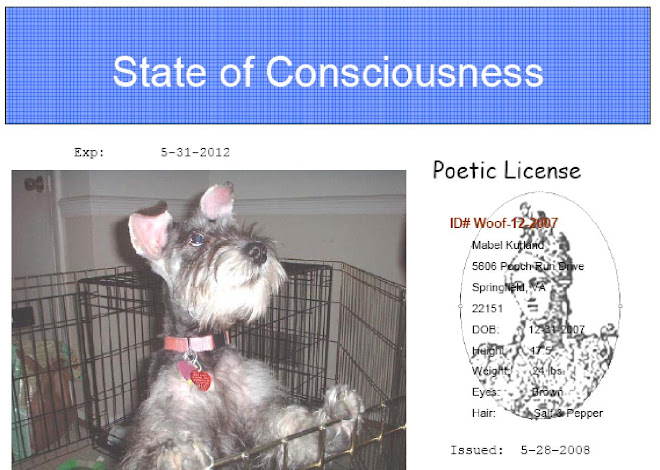
I got Mabel.

While dog walking in Accotinck without a recorded book, my mind spun this:

Tick, ticking time-bomb.
I am about to explode.
To the woods I go.

Mabel made me smile. She always does. Love that dog!

Wednesday, January 15, 2014

Dogwalk in morning fog

Thank you for the fog.
The glow of streetlights bathes us.
Droplets catch the light.

For a brief moment, as Mabel happily sniffed for canine messages, I was able to drift from the press of obligations and meditate about everything that I can be thankful for, and be non-judgmental about behavior problems that come with the territory. This morning, no audiobooks -- only whir of stirred up memories, snippets about Napolean Hill's exhortations to develop the habit of "definiteness of purpose," from Think and Grow Rich, the "thank walk" episodes from Rhonda Byrn's The Secret, the jingle of Mabel's collar, and lovely visuals. Totally unfocused, and loving it!

Today, when Joe woke on his own for his first 6am baseball workout -- a miracle -- I was reminded of Tony Robbin's conclusion from Lessons in Mastery how we make major life changes in the blink of an eye, changes from Saul to Paul, where scales fall off our eyes. We will see. Consistency is the key. The kid has talent. Maybe the words of his coach and the promise of playing time spoke to him. We will see.

Hopefully, my 3:30 am wake up does not lead to afternoon fog. Can't afford it. Was cutting up manipulatives for today's discovery lesson about mathematical properties.  Was allowing my IEP goals for Justin to percolate, was worried about all that I don't know about the IEP process. 2 IEP meetings this week. Have never done this before. Major test in US History Friday. 2 major math tests next week. End of the 2nd quarter. IEP Progress Reports due. I am thankful to have a job, thankful that I can pay the bills, thankful that nothing major has slipped, thankful a childhood friend wants to renew an old friendship. Lots to be thankful for.

Friday, January 10, 2014

They came

It was an odd week. During 3rd period Social Studies, Rex, a student who I support in Mr. Li's math class, asked if I would help him on his math project after school. Normally, I don't accept students on Fridays after school, but with the 2nd Quarter Project due for 6th grade next week, I relented.

Apparently, the word went out. After school on a Friday, my room was filled with students from Mr. Li's classes, who came for help with their algebra modeling project, hoping to avoid the wrath of Kahn. A group of students from my self-contained classes also came in response to my expression of extreme disappointment that not a single student from my first period had turned in their project, except for Mohammed, and promise that I would be making calls after school today, something that did not happen because I was working with students on their projects. Even Kelvin, a student from my difficult 4th period class, upon whom I hope to one day model a Cyclops character, hung around. Although Kelvin did not work on his project, he stayed to impress all the girls and his friends who were there, despite my having contacted his mother last night via email to report to her that I had logged over 10 incidents where he had disrupted my 4th period class yesterday, including inappropriate language, and other negative attention seeking behavior, despite my having smiled like a Chesire cat as I informed him that we would be working on skills at his apartment tomorrow, and winked to other students and said, "just kidding," although Kelvin and I both knew I wasn't kidding.

With several annual IEP's coming due this week, this week I focused on reserving time and space in the Conference Room, notifying parents, sending out invitations to attendees via Outlook, asking Ms. Jones to draft writing Language Arts goals, and asking for procedural clarifications throughout the week. Last night, I came back to school around 6:45pm, and worked until about 9:30 on setting up IEP's. Then, I shifted gears to prepare for launching a new unit on the Properties of Operations by printing materials and doing a quick read of the Day 1 presentation.

Of course, when I felt the least prepared, Dr. P dropped in to observe my 1st period class. Since Dr. P did not wince, and since when I asked for a thumbs to the side or thumbs up when I came across him in the hall, the observation apparently went okay. Although I was rather embarrassed about my lack of preparation for today's lesson, having accepted the advice of the school's instructional coach, my board listed the correct standard of learning, the room was neat, my vocabulary was posted, the objective and teaching method were all listed. At least I did not embarrass myself in front of Dr. P, as my first period class cooperated, and evidently remained sufficiently engaged. Sometimes, good enough is good enough.

Two days before, Ms. English had dropped in after school to inquire about a student in Mr. Li's class who had complained to her about Mr. Li. Ms. English mentioned that she would be dropping in to observe Mr. Li, and wanted to hear my views on the matter. Later that night, I expressed my misgivings to John Park, who keeps his desk in my room, and explained my reluctance to say anything negative about a colleague, especially one who does so many great things from an instructional standpoint, who often helps me, and whom I like, despite his routine use of public humiliation, a practice which makes me uncomfortable, and which I try not to do. That morning, Mr. Li asked me to lead the review of graphing and translating inequalities while he made copies for the new unit. Ms. English, our 6th Grade Administrator dropped in as students were answering inequality graphing and translating questions on the Smart Board, and she got to observe my special ability to make a student feel comfortable about making an error, while I helped the student discover her own error without embarrassing her. Mr. Li returned, retook the lead, and I went back to my normal support role in his class.

In my Special Education Teacher training in Marymount University's graduate school program, I had to take an entire course on collaboration and co-teaching, a course many considered a "fluff" course, but here I was prepared for handling a situation that otherwise I never would have considered. The course revolved around modeling the process of how to navigate shifting roles, how to evaluate situations from all sides, how to clarify and define my roles and responsibilities as a Special Education Teacher, and how to utilize common procedures within a team setting, in order to come up with a plan of action for a particular student. In this case, the student, Sophia De' Chardin, was not even a student on my caseload, but somewhere along the line I had learned as a co-teacher to view the students in the room as my students.

Somebody once said that a Special Education Teacher needs to have a strong identity, must be able to be a counterpoint to the General Education Teacher, which helps to explain why my presence tends to make Mr. Li slightly uncomfortable. As a Special Education Teacher, I have no problem taking on the role of the "Un-Cola." When Mr. Li went on a 10 minute rant about students who were unable to fold a paper in thirds, strongly inferring that any 6th grader who could not fold a paper in thirds was stupid after Rex came to me for help in folding his paper, I sensed that there would be unforseen consequences.

Sunday, January 5, 2014

I'm going to be a guinea pig: Probiotics in my Neti Pot to cure sinusitis

Heal Sinus Infections with No Antibiotics (Really)

I'm a tad impulsive. After opening up e-mail from from some health-site -- I'm on a few distribution lists, probably because I checked a box for diabetes -- I listened to one of those advertisements where the artist draws visuals that accompany the presentation, and based on the symptoms they described, I came away with the fear that I have an overgrowth of a parasitic fungus called Candida. Yes, Mom, self-diagnosing, self-treating, exactly what you always tell me not to do. Their explanation made perfect sense. And, Dr. Oz did in fact address this topic.

According to the presentation that hooked me, and persuaded me to open up my wallet to buy their Keybiotics probiotic supplement, Candida overwhelms other microbes inside the body as a consequence of high blood sugar, and even sends chemical messages to the brain to "feed me" -- a direct allusion to some B-Movie I recall from my childhood but cannot name. To fully eradicate this "American Parasite," people need to change their diets, away from processed foods, away from food products produced by agribusinesses such as wheat, even dairy fed on grains, and go "paleo," plus reseed their guts with good bacteria.

According to the article featured above, this might hurt a little, but it's worth a try. I need my energy, since the 2nd half of school begins tomorrow, and I need to do whatever I can to overcome feelings of overwhelm, mind fog, etc., and become more organized than I ever have been before.

My school computer has a crashed hard drive, which, fortunately, I discovered immediately after my holidays started. I can't imagine how deflating it would be to show up at school, only to discover that my computer was not working. Talk about a miserable Monday.

I wasn't able to do reports I need to prepare for my mid-term evaluation. I wasn't able to pull up IEP's and reports I use, stored on the server, that help me manage my caseload. Since I had arranged with Dr. P to get in on December 26th, I did, however, make all my copies and was able to downloaded materials I need to teach and store it on my Skydrive. Disaster averted.

Tony Robbins reminds that fear can be a very useful tool, if one heeds the message: "get prepared." The message of Candida is there are no quick fixes, and that a cure for chronic fatigue, mind fog, sinusitis, itchy skin, etc., depends on wholesale lifestyle changes.

Meanwhile, bring on the Neti Pot.

Saturday, January 4, 2014

The Payoff

In class, Pablo has been both the poster-child for learned helplessness and a source of daily annoyances. Pablo's body language has both infuriated and saddened me as other children have cheered on occasions when I have had him removed from the class so that others can learn. I have moved him away from students so that they cannot hear his steady stream of insults, away from walls so that he cannot lean his chair back against it, faced him away from other students so that his poisonous attitude does not infect the entire class. In The Teacher's Concise Guide to Functional Behavioral Assessment, Waller explains:
"Research has shown that only a few things serve as the function for the majority of misbehavior at school: attention, escape, tangible items, and sensory input issues (sometimes called automatic reinforcement)" (Waller, 2009).
After describing four primary drivers of misbehavior, Waller adds a special discussion of how "skills deficits synergistically impact any of the four functions of a target behavior and worsen that target behavior." (Waller, 2009). In the case of Peter, Pablo, and Kendall, direct-instruction seemed to trigger most episodes of cross-classroom insults, outbursts, and negative attention seeking behavior. I reflected that I needed a better system for remediating skills deficits, since my full-court press at lunch or after school efforts to help students learn simple fraction-decimal operations with students were not reaching students who either were not able to attend, or when they attended disrupted sessions, which had been the case with another leg of the three-legged stool, Peter, a special case with "sensory input issues."

When the counselor, Peggy DeForrest, as part of an On Time Graduation Initiative, asked why his Interim report card showed that he had earned an F for the 2nd quarter, my response was that Pablo had done nothing in my class all year, that I had conferenced face-to-face and started regular e-mail discussions with Pablo's father, Salvador about how we might begin more aggressive interventions. Peggy's query prompted me to reflect deeper about the effectiveness of my practices. Dr. P expects us to send home progress reports every few weeks, which I had been doing -- it turns out, Pablo, Peter, and Kendall had been hiding their interim reports from their parents. My good friend Tim, who was directly responsible for bringing how I teach to Dr. P's attention, watched Peter throw his Interim Report Card on the floor. I hand-delivered the report to Peter's house just before the holidays, and used the incident to help frame my Christmas Eve intervention with Peter. I had to be honest with myself -- I had not been doing a good enough job making sure that these reports were coming back signed. By making friendly calls or emails to virtually every student before the holidays, I was able to determine who had and had not been seeing these reports. I know I need to tighten up with the use of checklists.

Pablo fit most criteria for being included in On Time Graduation Initiative at-risk reports, having been transferred from an Alternative School, excluded from his base school, and failed most State Testing. Just about all of my students fit the at-risk category, with poverty, learning disabilities, and major skills deficits as givens in the classroom landscape, and many of my students have either an Academic Coach or are involved in a mentorship ship program.

The holidays have given me breathing room to reflect on my procedures. Reshuffling seating arrangements to test how various combinations of students worked together and quarantining the most extreme behavior problems had made significant differences and had contributed to making the learning environment more compatible for learning, but the gap between the standards and prerequisite capabilities put a limit on the effectiveness of that kind of intervention. My outreach efforts have been broad, and I have been able to reel in students who are motivated to learn, but Pablo who has mastered the art of work avoidance, mocked my requests with his ineligibility to take a late bus home.

The smugness with which Pablo smiled as he repeated his inability to take the late bus home, and his purposeful disruptiveness during lunchroom interventions led me to the conclusion that either I needed to take formal action to protect the learning environment, or I needed to find a more creative way to reach him. Pablo cried crocodile tears when I first showed up at his Tower Apartment, and Salvador and I scheduled a series of private sessions over the holidays, but we replied, "If you had used your class time to learn the material, we wouldn't have to use your time over the holidays."

After four two-on-one interventions, of between two and four hours in duration, while Pablo continues to have skill deficits, he now knows that, in math, there is no fooling, because the numbers do not lie. He knows that we have "Playbook" which shows step-by-step procedures for every math procedure in 6th grade, he knows how to access every note, every Power Point, every vocabulary poster, every chart, and how to access the National Library for Virtual Manipulatives. I have shown him several different strategies for doing multi-digit multiplication, how to do long division, how to read decimals with place-value language, and perhaps most importantly, the importance of showing every step in recording his math thinking. I have Salvador's cellphone, and he has mine.

Pablo knows that I plan to recommend him for summer school, but he didn't cry when I reminded him of that virtual inevitability. He knows that, if he does not practice at least an hour a day, he will likely be repeating 6th grade math with the rising 5th graders. I concluded, "I doesn't bother me if you fail the state testing, as long as you fail the right way.

Waller, R. (2009). The teacher's concise guide to functional behavioral assessment. Thousand Oaks: Corwin Press.