http://www.loc.gov/teachers/classroommaterials/
Not that the Library of Congress does not want to promote the people's online library, but most people honestly do not know about the treasure trove of knowledge that lies right at their fingertips. A revolution in the way people learn how to learn is possible, from "stand and deliver" to a "student centered" approach to inflaming young minds with a passion for learning essential skills and knowledge. Spread the word, your taxpayers and the blood of patriots paid for these online resources.
As a student of the latest approaches to Special Education, Universal Design for Learning (UDL) is an approach that dovetails best with the style of learning that enabled me to overcome my own executive function challenges and succeed at Georgetown University and beyond. Universal Design for Learning is based on an architecture metaphor rooted in the Americans with Disabilities Act (ADA) -- if we enable people with learning disabilities to more easily access the General Education curriculum, we facilitate access to all people in the process. Just as curb cuts make access to a building easier for everybody, making the people's primary sources more easily accessible to people with learning disabilities makes them more accessible to everybody.
Universal Design for Learning is technology-oriented, whereas there was no Internet when I was growing up. Similar to the many ways curators of the online Library of Congress have made primary sources universally accessible, I was taught how to hunt-down primary sources in DC to complete personally meaningful projects. In high school, I took a bus ride to the National Archives in Washington. Today, students can ride the Internet.
Friday, September 9, 2011


Sunday, September 4, 2011
New Lyrics
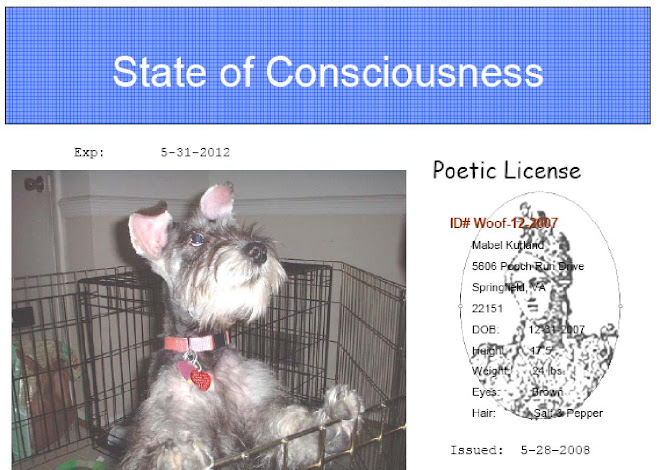
This song is for someone I care about who recently told me her sad story. While walking Mabel this morning, the lyrics kept evolving, so had to write them. Not like I have any time to strum my guitar or write poetry, but my ADD wouldn't let these lyrics die.
It wasn’t you
I have to find that girl who's more like me.
It wasn’t you
I was as blind as I could be.
It wasn’t you, it was me.
I had to find a girl more like me in the bars.
I was the guy who was corporate-clean.
My star was rising up AT&T.
Then I saw you in your blue jeans.
I had to know what I could buy you that night.
Your curls looked so heavenly in the moonlight.
I had to build you castles in the sand.
You were the cool girl I could never understand.
You were the darling of everyone in the band.
You stretched me like a rubber band until my heart snapped.
You never came. You never blamed. You never cried.
You just sat there stone faced when I dumped you.
Now I’m texting you again from the bar.
I’m going far. I’ll buy that car. Do you still miss me?
I’m on my way to that corner office.
In five years I’ll be worth my weight in gold.
Please never unfriend me on Facebook.
I wasn’t just some one night stand.
You were nothing I ever could have planned.
Follow me on Twitter. Please don’t be bitter.
I have to find that girl who's more like me.
Monday, August 22, 2011
Summer's Close
Thanks to some really cool teacher friends, neighbors, and family memeors, I managed to survive the summer semester, where I was taking 6 courses, 5 of which were master's level. Without the support of several people who gave me access to their classes, met with me at Starbucks, and allowed me into their homes, I wouldn't have had anything to write about. In the process, I refined my view of early childhood education, a hot field that is increasingly being seen as an antecedent to special education, the field where I am specializing.
After the school year was over, I took a short beach vacation to Donna's beach house. Mabel, my beautiful pooch, was a great travel companion, but she was happy to get home to her familiar scents. Karen, Joe, and Donna stayed for the full two weeks, and Joe seemed to grow 2-3 inches while I was gone. I needed to rush home to work on the yard. The wild grape had taken over a corner of the yard, so that eyesore needed to be removed. My old friend Ricky and I tore down the old shed, and we weeded, trimmed, and gradually brought some order to the yard. Over the next few days, we'll put the finishing touches on our landscaping project.
Next week, I will begin student teaching about an hour away, and will be taking three classes. Life is about to get very painful, but as the Dean of the Education reminded me, I need to keep repeating to myself, "I'll have my Master's in a year, I'll have my Master's in a year." On the reading list is Harry Wong's The First Days of School.
Thursday, July 28, 2011
Field Experience
Throughout my life, the most enduring lessons have tended to be the ones that have brought me the most pain. My frustration with Field Experience nearly brought me to tears several times this semester, but men do not cry. Throughout the process I had the nagging feeling I was being set up for failure. Having followed the example of William “the Conqueror,” having allowed zero room for retreat, I was feeling overwhelmed by the paperwork. Then, as if angels started opening doors for me, relationships I had long nurtured began bearing fruit. First, the secretary at the middle school where I had done a lot of subbing found me a student for my Curriculum Based Assessment project. Next, Mindy, the mother of one of my Kindergarten students, a Speech Pathologist, responded enthusiastically. Then, Harriett, the teacher for whom I had launched a kindergarten class in September, invited me in. Eventually, my relatives, some dear old friends, and some neighbors helped me rally so that I could finish strong.
Universal Design for Learning provides an architectural metaphor for the barrier I faced in getting field experience: a lack of access. Despite long-standing personal connections, trying to get into schools in May and June this spring was like trying to make cold calls as a salesman. It felt like constant rejection. Carla, a secretary at a local Title I school, who had called on me in desperation early in late August to see if I might launch a Kindergarten class, had become a gatekeeper. My former colleague, the Reading Specialist who had recommended that I go to Marymount, became impossible to pin down. The lead Kindergarten teacher, who had gone out of her way to set me up for success, who had always been available for a few minutes, never checked her email. The special education teacher, who had sent out glowing emails around her school about me, never returned my emails. The long tenured principal at our neighborhood elementary school had retired. My son’s current principal, an amazing educator, never returned my email. Even my relative and her best friend could not give me a firm answer. I’m not sure what I would have done if the Jedi Academy Middle School, where I had often subbed, had not found me a student for my Curriculum Based Assessment (CBA) project.
With the end of school quickly approaching, with zero time to spare and with only the faintest idea of how to do a CBA, I launched myself into the classroom with the task of teaching scientific notation to a child with autism. Having taught math to 3rd graders and 4th graders in two Title I schools, having been formally trained in Math Investigations, I had strong convictions about why a 7th grader might struggle with scientific notation. First, I reviewed the SOL. Next, I pulled out my 3rd grade fraction unit, with which my Title I Math Specialist and another 3rd grade teacher had guided me. Then, I grabbed my tattered of Elementary School Mathematics. After reviewing Van de Walle’s strategies for connecting models to language and procedures to models, I scoured websites for the right assessment. Unable to find the right assessment for Luke’s instructional objective, I developed one for him. After compiling a set of core problems, many of which were extracted conceptually from IXL’s website, I incorporated base-10 and fraction representations in Luke’s interactive notebook pages using special math fonts. Lastly, I picked up a set of base-10 blocks from Lakeshore Learning and met Luke, a child with autism with a passion for Star Wars. A mutual passion for everything Star Wars provided an immediate bond. In building rapport, I shared with Luke how my son, also a 7th grader, had read every Star Wars book he could get his hands on. While producing the graphs for the CBA, I had an Aha moment! I finally understood the power of using data to drive instruction. A Jedi Master at Excel, I now saw how a tool that I had mastered long ago in practicing the dark arts of accounting could be used to actually help people rather than an annoyance. Data from the CBA allowed me to identify the wide discrepancy between Luke’s strengths and weaknesses. Based on the data, we could develop a plan to scaffold step-by step processes that he could use whenever solving math problems. In order to become a designer of computer games, Luke needs to master fractions and other problem solving skills.
Sparked by what Dr. M had taught us about the work of Jim Cummins, I was excited about my upcoming meeting with Mindy, a Speech Pathologist, at a local Child Find school. During morning meeting at a preschool Autism class, I witnessed a child who had entered her classroom during the spring with zero expressive vocabulary, in June, experiencing a language explosion. Mindy shared with me her notes which documented how she had worked with Barry hand-over-hand to get him to speak his first words, connecting words to physical objects and pictures. She explained how the child’s grandparents were supporting the child in every way imaginable. Meanwhile, the lead teacher was using a felt board with pictures of the children, plus representations of the home, bus, and school to welcome every child to school with a song. The Instructional Assistant was sitting with the neediest children. Mindy pulled me aside and shared with me the life of another little boy in the class who was not thriving. Likely the product of an incestuous relationship, she observed, his uncle looked and behaved, strikingly, more like a father than an uncle. Afterwards, Mindy took me to a 3-6 grade self-contained classroom that she supported, where the teacher had disappeared without a word just before the testing season. There, a child with burns over every inch of her body, moaned and groaned every time her teacher asked her to do any work. Mindy confided that this child’s difficult behavior had sent the teacher over the edge. I watched how, as the long-term sub delivered a scripted Read 180 lesson, a paraprofessional compassionately moved the moaning child to a seat away from the table, where she immediately calmed herself. Mindy found a moment to point out all the great things the long-term sub was doing, quietly moved next to a child, and helped him with his word sort. Later, Mindy invited me in to meet with the Child Find director. We had a brief conversation about Child Find’s role in early intervention in the Director’s office.
Before I left, Mindy shared an anecdote about a home visit she had recently conducted. The child’s father had called the Child Find number because, at 3 years old, his child was still not speaking. She had been knocking at the front door for a while and was preparing to leave, when a large man from Ghana finally came to the door. He had come to the door not wearing a shirt, looking completely disoriented. He had forgotten their appointment. In the living room, several men were sleeping on the floor. A small child was sitting alone in a dark corner with a pile of toys. The father worked all night. The mother worked all day. Having recently completed a Psychology Course at ...College, I was reminded of the importance of early exposure to a language rich environment. I glanced over at Mindy and uttered, “Isn’t that neglect?” She nodded and shuddered. That night, after class, I visited Mindy’s blog, considered her wonderful record of everything her family does together, and reflected, “No wonder her son Allen is such a gifted writer!”
As a pen-pal, I had remained connected to Mindy’s son’s Kindergarten class after Allan’s teacher Harriett returned from maternity leave. I was committed to be there at the year-end Kindebration. In our emails, when I broached the subject of observations, Harriett told me just to show up any time during language arts, so I did. Carla, however, was far more formal about sending me back to the classrooms than I had expected. She turned me away. Even when I had a scheduled appointment the next time, I was made to sit out in the hall for over an hour before Rosanne, the Accountant, finally grabbed me and brought me back to the reading room, where I waited another hour for Noreen, the Reading Specialist. Noreen asked me, “Why didn’t you just come back?” She broke for lunch and returned an hour later, only to head off to a series of meetings about the summer school classes that she would be running. Afterwards, I emailed Harriett, who was surprised to hear about the problem and sent Cara a note that I would be coming at such and such time. Finally, a few days before the end of school, I managed to observe Harriett conduct a lesson. Harriet is one of the strongest teachers I have ever seen, and would have been a great person to shadow, since I had launched her classroom in September.
On the way back to Harriet’s classroom, I noticed something that disturbed me. Jeanie, the Counselor, waved me over to the teacher’s workroom excitingly. There, I greeted all of the class’s struggling learners “working” with Mr. T, an Instructional Assistant with a gift for making everybody comfortable. My little friends had been coloring a worksheet with little apparent instructional value. Donald, whom I had referred for language screening, who we could never leave out of our sight because he might bite, push, or otherwise bother the lovely Lori, a child who spoke three languages fluently, greeted me warily. Ricky, a twin, with street smarts, whose perfectionism hindered his acquisition of academic knowledge, but whose drawings reflected artistic talent, hugged me. Allah, whose drawings were mostly scribble scrabble, who rarely paid attention at the carpet, during math, reading, or writing, but who always seemed to find another gear at recess, high fived me. Little Jimmy, who had suffered a broken arm just after he had his appendix removed, who for three weeks had been unable to run around during recess, and had missed out on gymnastics, who was constantly popping up during naptime with his little frog blanket, smiled up at me broadly. Narnia, who loved to recite Silly Sally, but who still could not write her name, gave me a big hug.
In the classroom, Harriett rewarded children during a quick game involving phonemic awareness as she released them from the carpet. It occurred to me that Mr. T’s group had been regularly removed from the class for the sake of the others. Mr. T’s group returned as snack time was starting. Lola, the Instructional Assistant, passed out Ant Journals as the children sat down for snack time. Harriett proudly pointed to her new Smart Doc camera, which she was using to project the Class’s ant farm. Then, as the students were snacking, she presented a science minilesson that connected what was occurring on the screen to the kinds of things they could be writing. She held up Allen’s journal, which had sentences and detailed drawings, as an exemplar. A few days later at the Kindebration, each child was given a role in the ceremony. Harriett handed me the clipboard, and like old times, I released the children to their parents.
I have been focusing on language acquisition this semester, both at __ and __ College. My burning question has been, what are some of the advantages of a child like Allen, who seems headed for the gifted program, that are missing in other children’s homes? To get some clues, I visited the home of a relative, whose 3rd grade daughter recently won a national science competition. I was there to do a language observation of O. O was 6 years, 6 months, and 20 days old when observed. The first setting was alone with the observer in a homework room. The other was in the kitchen – her sister was getting a cooking lesson from her dad, her mom was in the background, and I was talking with O and her dad. Highly imaginative, O referred lovingly to her stuffed animals, “Floppy, Fluffy, and Lucy,” to which she had referred in drawings, but could also describe real-world details about her ballet recital, vacations, plus experiences at school, playing the Wii gaming system, plus everything that was going on in the kitchen. While O overgeneralized irregular endings, e.g., “growed,” instead of grew, and “shrinked” instead of shrunk, and mixed tenses, e.g., “was” instead of “were,” she often self-corrected. O’s command of prosodic elements of stress, pitch, duration, and tone made O sound to me more like a little adult than a typical 6 year old. The following is a snippet from our conversation: “I love whisking the pancakes when he makes it–banana chocolate chip pancakes.” Her father handed her a spice jar to read: “Smoked Spanish Paprika.” How does evaluating the difference between regular paprika and smoked Spanish paprika, or tasting what happens when a dash of imported sherry vinegar is added to melted cheese, affect the brain? O cooed, “Mmm, yummy!” I left wondering how the cooking lesson had changed her.
I caught up to my relative Deena in a coffee shop later that day, where I interviewed her about her experiences as an instructional assistant with 20 years of experience. Deena uses computer labels to record how every child she works with during language arts does on a daily basis. Her notes become an integral part of her teacher’s notebook of anecdotal notes. Although now classified as a Special Education Instructional Assistant, she has been working with a K-1 team, where rising kindergarten students become 1st graders, and serve as mentors to incoming kindergarten students during the fall. After the interview, Deena shared with me what it was like to have a child who was twice exceptional, GT / LD. Deena went back and located her daughter’s Individualized Education Plan records for me, giving me a window into the entire history of how the eligibility process unfolded, and why the process had been so frustrating to her.
Sara’s best friend, Sara, responded to my distress signals by inviting me to hang out this summer at an institute for the fine arts. Like she does every summer, Sarah is teaching 7th through 12 graders how to do tessellations and cartooning. Through tessellations and cartooning, students learn to identify character traits and apply that knowledge to find unique characters. They practice sequential planning, develop fine motor skills, and synthesize elements of graphics and language to create original imaginative stories. Of particular interest to me was how Sarah adapted lessons for students with disabilities, because I want to make cartooning more accessible to every student in the classroom. While there, a cadre of top county officials paused outside of Sarah’s door, oohed and aahed at the displays of student work, and introduced themselves. I wondered how I could borrow some of what I learned about cartooning into my classroom.
Wally liked to pop into Sarah’s room, and I knew him as the Social Worker who had run the Child Study meetings when I was teaching 3rd grade. I interviewed Wally about his role in the eligibility process at a Title I School. After a child is referred to the local screening committee, he told me, the Social Worker and Psychologist look for things that either rule things in, or rule things out. In background research, as the Social Worker, Wally looks to see whether there was a “funky birth,” what is happening in the home life, whether there is an ill parent, whether the child is staying up too late at night, etc. Factors in the child’s environment that might be impacting the child’s learning might help rule out a learning disability as the reason why a student may be having difficulty accessing the curriculum. Is the child tired, sick, are there other cultural and linguistic factors, or is it a learning disability? My 3rd graders had rudely awakened me to the issue of the instructional match when I tried to use James and the Giant Peach as a read aloud and I saw them looking back at me with blank expressions.
A neighbor, whom I had helped move a bookcase on the day he had moved in, repaid the favor tenfold by allowing me to administer the KBEA-II Achievement test to his son. James Neutron, age 9.8 on the test date, who has been living abroad, most recently on a military base in Germany, has been home schooled by his mother, a former teacher. James’s composite score registered in the upper extreme on all test takers.
What began as an exercise in frustration became a series of burning questions. Why did Narnia’s mother not use the textured letters I made for her daughter so that Narnia could practice with her letters? How could Luke struggle so much to keep track of procedural steps but remember every detail of every Star Wars episode? How did an ordinary cooking lesson, given to a sibling, affect a younger child’s language development? How were poverty and delays in language development related? These are questions that continue to burn in me. With no going back, the way forward challenged me to go out and explore in ways I would never have anticipated.
Wednesday, July 20, 2011
Sarah's Class
(All names have been fictionalized)
By Daniel Kurland
July 19, 2011
Sarah has been teaching art in public schools for over 20 years, mostly in elementary school. This summer, at a Summer Fine Arts institute in a local high school, Sarah is teaching tessellation and cartooning to students aged 7-12. Through tessellations and cartooning, students learn to identify character traits and apply that knowledge to find unique characters. They practice sequential planning, develop fine motor skills, and synthesize elements of graphics and language to create original imaginative stories. Of particular interest to me was how Sarah adapted lessons for students with disabilities, because I want to make cartooning more accessible to every student in the classroom. I was looking for ways that classroom teachers might adapt some of Sarah’s cartooning ideas to provide students an alternative to traditional pen and paper response tools.
Sarah’s tessellation lessons start with the work of M.C. Escher. To build background knowledge, she exposes students to cartoonists such as Herblock, Charles Addams, and other cartoon masters that might inspire them, but she teaches pattern first. In both tessellation and cartooning, each character emerges from the same shapes, repeated across the page. To find the characters within the free form lines of the pattern, students tap into three things, knowledge of character, emotion, and story. According to Sarah, “find the eyeballs, find the character.” Characters are most differentiated by eyes and mouths, which are used to show emotion. In characters created by students with autism that Sarah showed me, the eyes tended to lack the differentiation and vitality of cartoon characters shown by typical students. Stories develop in sequence, often through subtle changes in expression. The tessellation format is ideal for helping students learn the process of making sequential or themed changes.
Sarah reflected, “The hardest thing for young children is to not to want to copy what they already know. They need to get past that.” Some students get stuck on an image, so Sarah is constantly looking for ways to move them along. In using cartoon cells, Steven, a child with Autism, was producing the same robots over and over. She noticed that the animation cel structure was confining Steven’s ability to create a longer sequence, so Steven was encouraged to work on a larger sheet of paper to create a series showing the evolution of the robot. Although emotion was lacking in the eyes, the child produced an image that eerily echoed a famous image Sarah had showed him that showed the evolution of people. Sarah explained, consistent, focused attention is necessary in order to attend to subtle details about the eyes and mouths and demonstrate changes in character. One strategy Sarah uses to accommodate people that miss the emotion or gesture is to teach them to draw the reaction, since people often rely on pre-planned responses.
Another way cartooning and tessellation helps is in story development. Cartoon bubbles enable students to create dialogue. Even the cartoon method of making strong exclamations is highlighted: *%#!! Cartoon bubbles help children identify the most salient details of speech, which makes it a great way to teach summarizing skills. According to Sarah, children with learning disabilities often have problems getting pictures into words, and cartoon bubbles help learners visualize conversations and story development.
All students in Sarah’s class are exposed to strategies of professional cartoonists, which Sarah has adapted to simplify the process even for younger children. Rather than a full page 11x17 or larger strategy used by traditional cartoonists, Sarah teaches students to work within a cel structure, with pre-cut cells numbered on the back as an accommodation. That encourages students to draw bigger, and keeps them organized. Drawings must touch all four sides of the cell, which helps bring lines out and improves line quality. Students are taught cross-hatching, stippling, and negative space to develop the illusion of texture. Mark, a student with blindness, who had a full-time interpreter, explored the concept of developing texture in his tessellation. At one teachable moment, Sarah took a moment to explain the importance of copyright protection: “The Internet has blown the lid off the issue. I have had students have a strip in circulation before they were 18.” Ernie, Sarah’s intern, told a story about how a band had stolen his image, which raised student eyebrows.
If a teacher went through the process of cartooning, children could be given an entire process for expressing ideas in different ways – which is consistent with Universal Design for Learning Principles we have been learning. “They have to understand what is going on in the cel emotionally,” Sarah explains.
Generously, Ernie, a recent graduate of Virginia Commonwealth University, and a talented cartoonist in his own right, suggested some ideas I might use to start a cartoon center:
1. Provide preset panels (Page layouts: 3 panel, 4 panel, and Sunday).
2. Provide materials including light box, cartooning pens, prisma colors, t-square, good erasers, and light pencils.
3. Draft, edit, and publish procedures:
a. Write out a script in a sketch pad (draft)
b. Setup 1st panel (drawing out panel, starting with light pencil drawing, to be later lined over with ink
c. Change facial expressions (eyes, eyebrows, mouths) over following panels.
d. Add close-ups, talk bubbles, and other tricks of the trade.
4. Response activities: Read, and respond with a cartoon summary. Show examples:
a. Kafka’s Metamorphosis in cartoon (10 pages)
b. Pride and Prejudice
c. Fahrenheit 451
5. Scan cels into computer and incorporate into multi-media presentations.
Through the repetition of cels, and through subtle changes, students learn advanced characterization strategies. Cartooning and tessellating offers unique response options. Judging from student performance, proudly displayed on walls outside the walls, which a group of high powered local administrators stopped to notice, these strategies are clearly working
Friday, July 15, 2011
Subscribe to:
Posts (Atom)